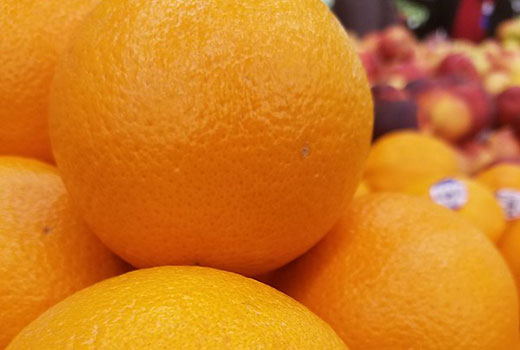
Grocery store produce may soon lose the price look-up sticker in favor of engraved QR codes.
No more stickers: Produce may soon be engraved with QR codes
K-State food scientist says high-tech labels may be coming to a grocery store near you
June 15, 2022
By Taylor Jameson, K-State Research and Extension news service
MANHATTAN, Kan. — A common annoyance at the grocery store comes from the peeling, often-lost price look-up - or PLUs - from many pieces of produce.
However, those stickers may soon be replaced by engraved QR codes; labels that would potentially save consumers time and frustration at the checkout line, and also make produce safer.
“Currently, the price look-up (PLU) sticker is used for inventory and pricing,” said Kansas State University food scientist Karen Blakeslee. “It is a sticker that can come off of the food at any point in time.”
Blakeslee said that the engraved QR codes would be laser engraved on each piece of produce. The codes would not be lost and would prevent consumers or cashiers from having to manually look up the price of produce that has lost its PLU.
Engraved QR codes may also make produce safer by reducing time spent tracing recalled food and reduce the amount of food that has to be recalled, according to Blakeslee.
However, she adds, it’s still a question as to whether these engraved QR codes may compromise the produce, leading to unsafe microbial contamination. Blakeslee noted that the Postharvest Physiology and Food Safety lab at K-State’s Olathe campus is currently pioneering research into engraved QR code food safety technology, as well as if it remains readable throughout the produce lifespan.
More about their research can be read online.
The most important factor for whether engraved QR codes make it to market, however, is what consumers think.
“We will see if consumers will accept this technology and the idea of a code being printed on the food,” Blakeslee said. “Consumer acceptance is key. Otherwise, it will not be a viable option.”
Blakeslee, who is also coordinator of K-State’s Rapid Response Center for Food Science, publishes a monthly newsletter called You Asked It!.More information is also available from local extension offices in Kansas.