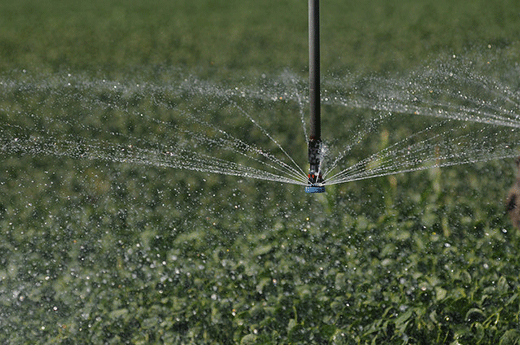
K-State researchers are studying water conservation and water quality issues to help farmers and communities in Kansas and the Midwest. | Download this photo.
Researchers taking team approach to Kansas’ water challenges
K-State’s Agriculture Today podcast airs series on current water topics
Feb. 21, 2023
By Pat Melgares, K-State Research and Extension news service
MANHATTAN, Kan. – The director of a Kansas State University program that works to address the state’s water challenges credits a team-first philosophy for progress being made to improve water quality and conserve available resources.
Susan Metzger, the associate director for K-State Research and Extension and director of the Kansas Center for Agricultural Resources and the Environment, said it’s common for K-State faculty to work together across several areas of expertise to study water issues.
“We really consider our work to be a cross-university partnership,” Metzger said. “We have researchers who might be sociologists or economists or agronomists or something else, all pulling together because no one discipline can tackle our water resource challenges.”
Metzger recently kicked off a weeks-long series of water discussions with K-State researchers currently being aired on K-State Research and Extension’s weekly podcast, Agriculture Today.
Water quality and conservation, Metzger said, “is not a new issue. It’s been a concern since before Kansas even became a state. It just seems to always come to the forefront of our attention whenever we’re in times of extreme drought, which is certainly what we’ve been experiencing in Kansas lately.”
Metzger noted a project in Hays, Kansas in which city officials and a K-State watershed specialist are working together to implement water quality and conservation practices within the entire watershed, or the land area that channels surface water to a single point from where it is accessed.
“They are investing in practices that improve their water supply,” Metzger said. “What happens in the watershed above our cities and towns impacts the water supply that we rely on for drinking water.”
That project “is focused on one community, but there are many larger, urban communities that can echo the same practices, too, and K-State has a role in all of those watersheds.” A project in the Little Arkansas watershed, for example, is helping to improve the water for the city of Wichita, she said.
In western Kansas, Metzger said Jonathan Aguilar – a water engineer at K-State Research and Extension’s Southwest Research Center in Garden City – has become the go-to guy for water research in that critical region.
Aguilar’s recent work includes a study of the perceptions of farmers toward water use in the region of the Ogallala Aquifer, a shallow water table aquifer that stretches across 174,000 square miles and touches parts of eight states, including the western third of Kansas.
“What we have learned is that creating a culture of conservation is a place where K State Research and Extension can be helpful,” Metzger said. “We're a trusted resource on the ground with local producers and communities, so we can help set up those conversations that build a culture of conservation that helps farmers adapt when there are new regulations or other tools. We're there to help them adapt to that change.”
Metzger said K-State agricultural economist Bill Golden’s work focuses on the economic impact of changing water quality or water conservation practices. She noted that his multi-year research has shown that farmers can reduce water use and still be profitable.
Through early March, Agriculture Today host Samantha Bennett is taking on the conversations regarding municipal water practices, as well as research done by Aguilar and Golden. Look for the podcast online at www.ksre.k-state.edu/news/radio-network/ag-today.html, or through your preferred streaming platform.