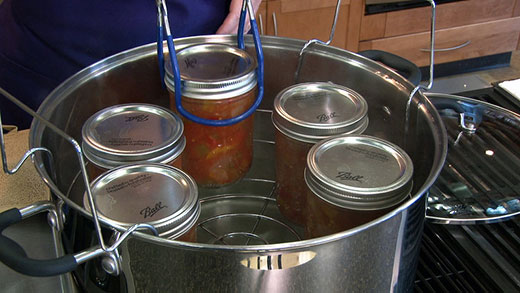
A canned product's acidity helps to prevent the growth of microorganisms.
Lemon juice and vinegar for canning
K-State food safety specialist shares do’s and don’ts of canning
Aug. 7, 2023
By Maddy Rohr, K-State Research and Extension news service
MANHATTAN, Kan. – Canning produce correctly is essential to safe food preservation. Two key ingredients to make many canned or pickled foods safe are bottled lemon juice and vinegar, said Kansas State University food scientist Karen Blakeslee.
“Bottled lemon juice is standardized, or uniformly acidified, per (U.S. Food and Drug Administration) regulations,” Blakeslee said. “Therefore, it is consistent, which provides a known level of safety for food preservation.”
The acidity of the product is important to prevent the growth of microorganisms that can cause spoilage or foodborne illness. Blakeslee said fresh lemons have an inconsistent acid, or pH, level.
“This can vary within the same variety of lemons, but also vary due to maturity, growing conditions, soil, fertilizer, rootstock and storage conditions,” Blakeslee said.
Researched and tested recipes have been created and evaluated to achieve the safest food product in the end, Blakeslee added.
“Taking shortcuts in food preservation can lead to spoiled food, foodborne illness and in rare cases, death,” Blakeslee said.
If using vinegar, the first step is to read the label. Look for vinegar that is 5% acidity.
“Today’s recipes use vinegar that has 5% acidity,” Blakeslee said. “Not all vinegars are the same. They range from 2.5% to more than 6%.”
If it is not 5%, it could lead to improperly acidified foods and unsafe foods after processing, Blakeslee warns.
“Do not use any vinegar labeled for cleaning purposes as they may contain other ingredients that are not safe to consume,” Blakeslee said.
Blakeslee publishes a monthly newsletter called You Asked It! that provides numerous tips on food safety. More information is also available from local extension offices in Kansas.