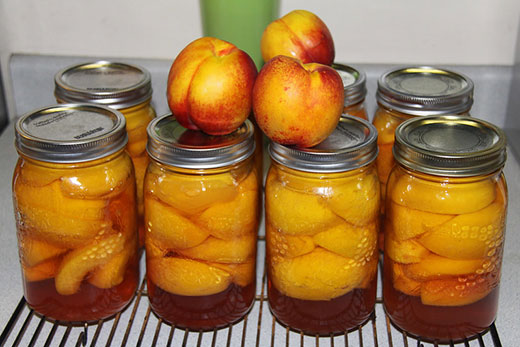
June is a time to prepare supplies for canning season.
It’s time for summer canning again
K-State food safety expert gives tips and tricks for new and experienced home-canners
June 13, 2022
By Taylor Jameson, K-State Research and Extension news service
MANHATTAN, Kan. – It’s that time of the year again when fresh produce is ready to be harvested, and many intend to set some aside to preserve for the fall and winter. Kansas State food scientist Karen Blakeslee said safety precautions are important when canning foods at home.
“If you are new to canning, learn how to use your canner before you preserve any food,” Blakeslee said. “Read the instructions for your canner. There are steps to follow in the process and none of these steps should be skipped.”
Listen to an interview by Jeff Wichman with Karen Blakeslee on the weekly radio program, Sound Living
Blakeslee recommends online how-to guides on pressure canning and steam or water bath canning.
Other safety considerations include:
Dial gauge pressure canners
Ensuring the dial gauge works on the canner is critical for food safety. Blakeslee said dial gauges need to be tested yearly, and many local extension offices in Kansas offer gauge testing.
“We can only test four brands, including National, Presto, Maid of Honor and Magic Seal,” Blakeslee said. “All American pressure canners have a dial gauge, but that is only used to indicate that pressure is inside the canner. Follow the weighted gauge action to achieve proper pressure.”
Preserving fruit purees
Fruit purees are a common and delicious way to preserve fresh fruits, but some fruits should not be canned at home.
“There are no home canning recommendations to can pureed bananas, dates, elderberries, figs, Asian pears, tomatoes, melons, papaya, persimmons, mango, coconut, white peaches or white nectarines,” Blakeslee said.
Blakeslee said pureed food should be pulsed – rather than blended -- to keep excess air to a minimum when using a food processor or blender. Excess air may not escape during the canning process, which could lead to a food safety hazard.
For more information on canning fruit purees, Blakeslee recommends an online publication from the National Center for Home Food Preservation.
Don’t forget to vent
Blakeslee said a critical step in pressure canning is allowing the canner to vent steam. Be sure the vent pipe is clean and free of food debris.
“After placing jars inside the warm canner and attaching the canner lid, set the stove burner on high,” she said. “Watch for steam to escape from the vent pipe. It should be a strong blast of steam that is visible in a funnel-shape. Let it continuously steam in this manner for 10 minutes.”
Allowing steam to vent ensures the pressure is properly maintained, and the temperature remains high to eliminate the chance of under-processed, unsafe food.
Canning in commercial jars
“There are many types of glass, and not all glass jars are tempered to withstand the home canning process,” Blakeslee said. “Additionally, commercial jars are not designed to be reused in home canning. The lids on commercial jars should also not be reused.”
Blakeslee recommends simply recycling commercial jars or reusing them to store non-food items.
“Preserving food at home can be done safely when done properly,” she said. “A national survey of consumers who preserve food showed that user errors cause 99% of canning failures.”
Blakeslee recommended learning more on the K-State Research and Extension web page on food preservation.
Blakeslee, who is also coordinator of K-State’s Rapid Response Center for Food Science, publishes a monthly newsletter called You Asked It! More information also is available at local extension offices in Kansas.